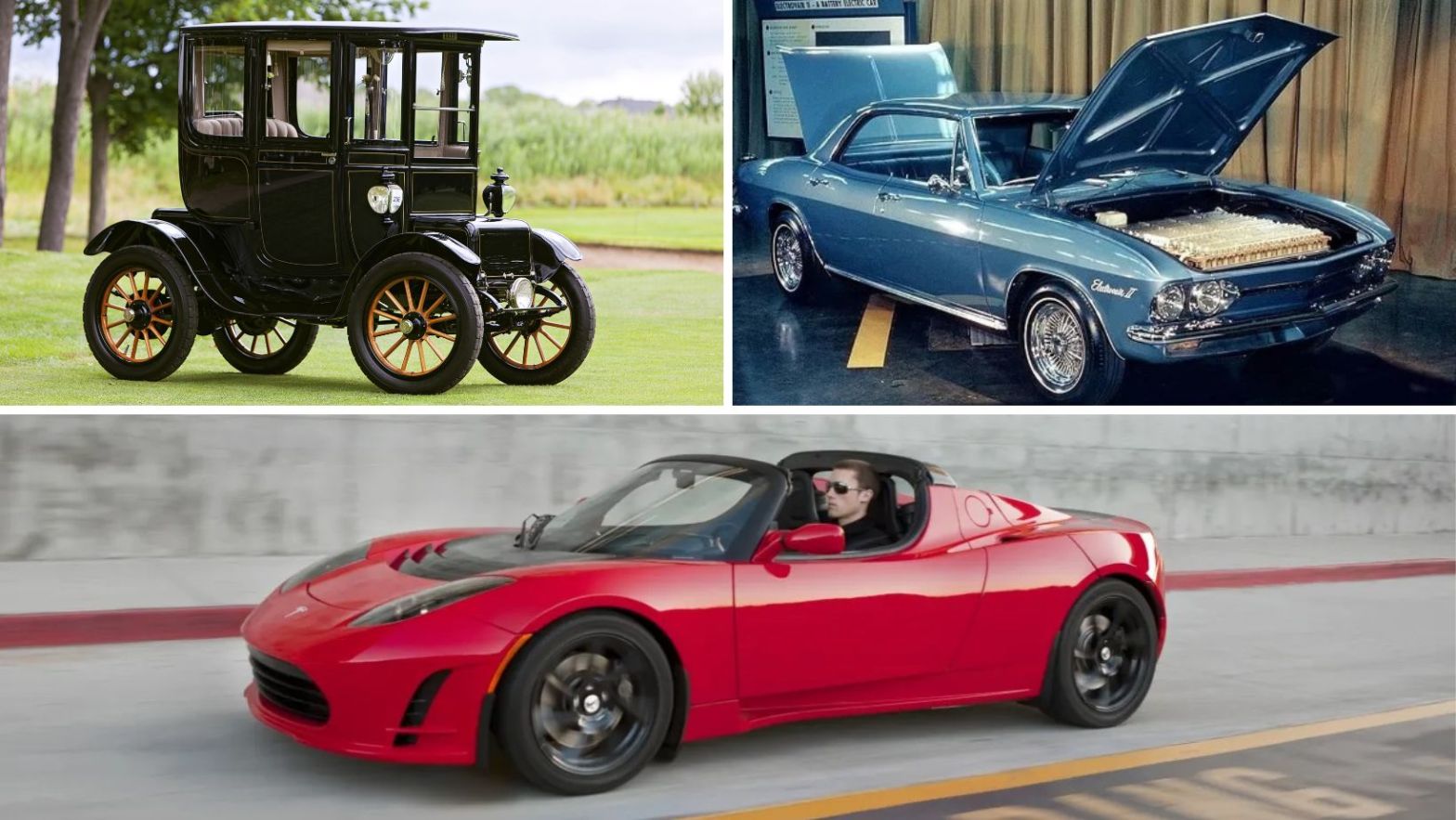
If you chit chat with non-car or modern car people, most are extremely excited about recent technology including EVs (electric vehicles) but in fact, electric vehicles are not a new technological advancement. Nope. It is OLD. Think: 19th century and the Gilded Age. Even the EV loyalist can become part of the collector car hobby!
In the mid-18th century, experimenters began toying with Leyden jars to store an electrical charge. Our very own Benjamin Franklin is credited with coining the term: electrical battery. But it is not until 1800 that Alessandro Volta (Italy) invents the first real battery of sorts, the voltaic pile. William Cruickshank (Scotland) then comes along and packs that pile into a box (trough battery). The first practical battery comes a year later, the Daniell cell in 1836 from John Frederic Daniell (England). Numerous cell types follow: Bird’s, Porous Pot, Gravity, Poggendorff, Grove…just to name a few. All of these cells use a fluid to maintain charge.
Finally in 1859, Gaston Plante (France), invents the lead-acid battery which is rechargeable. The zinc-carbon cell developed by Carl Gassner (Germany) in 1886 is the very first dry cell. It has a potential of 1.5 volts. It does not require maintenance like a wet cell, nor can it spill. The Columbia dry cell was first mass produced and marketed by the National Carbon Company in 1896.
Alkaline batteries are invented in 1899 by Walkemar Jungner (Sweden). The alkaline battery is commercialized in 1910; finally reaching the shores of the United States in 1946. Alkaline batteries were more expensive, as newer technology often is but having a better energy density, stronger than lead-acid batteries. Junger patents two types of alkaline batteries in 1899: one comprised of nickel-cadmium and the other, nickel-iron.
Thomas Edison develops and patents his own version of the alkaline nickel-iron battery in 1901. It went on to have enormous success. In fact, under the Exide Brand, Edison’s batteries continued to be manufactured through the mid 1970’s. We still use both alkaline batteries producing 1.5 volts (think any battery powered toy or flashlight) and lead-acid batteries producing as many as 24 volts (from wheelchairs to vehicles) today.
Lithium battery experimentation begins in 1912 with Gilbert Lewis (US). However, it is not until the mid-1980’s that a team from Japan led by Akira Yoshino built the first lithium-ion prototype. Akira Yoshino, John Goodenough (US) and Stanely Whittingham (UK-US) won the Nobel Prize in Chemistry in 2019 for their development of the lithium-ion battery.
Now, let’s talk cars:
Steam powered car 1769 France
Battery powered car 1832 Scotland
Gasoline powered car 1886 Germany
The first successful electric car built in the United States was in 1890 by Scottish born, William Morrison. It was a front wheel drive, 6-passenger vehicle with 4-horsepower and a top speed of 14 miles per hour. She made her debut in a parade in Morrison’s hometown of Des Moines, Iowa. It had 24 battery cells that needed recharging every 50 miles. Showcased at the Chicago World’s Fair in 1893, it became an overnight sensation and sparked the initial interest in electric vehicles. By 1900, electric vehicles accounted for nearly one-third of the vehicles on American roads including a fleet of more than 600 taxis in New York City with smaller fleets in Boston, Baltimore and other cities along the eastern seaboard. Peaking in the 1910’s, there were over 300 manufacturers building electric vehicles in the United States alone.
The electric car was the first to break the 60-mph (mile per hour) speed barrier in the Spring of 1899 with Camille Jenatzy (Belgium) behind the wheel of his La Jamais Contente (the Never Satisfied) torpedo shaped race car. Both Ransom Eli Olds and Doctor Ferdinand Porsche built an electric vehicle.
Like today, the lack of infrastructure inhibited the success of electric cars. Needing to overcome the limited range of electric vehicles, an exchangeable battery service was proposed in 1896. General Vehicle Company, Hartford Electric Light Company and the GeVeCo Battery Service were the first to put this idea into practice. Owners paid a variable price per mile as well as a monthly service fee. Electric cars held their own in the market through the early 1900’s. They were excellent for city driving and particularly marketed to women as most had no desire to hand crank an engine.
The first stage of failure came in 1908 with the Ford Model T. By 1923, the Model T was priced under $300. Electric cars were ten times that cost. Great strides had been made with battery packs (25mph with a range of 80 miles), but it came at a high cost. The upgraded battery alone was double the investment of Mr. Ford’s car. Next: the electric starter. Developed by Charles Kettering of Dayton Engineering for the 1912 Cadillac, the electric starter did away with hand cranking entirely. Finally, the US highway system and the discovery of Texas crude. Most rural Americans did not have electricity even in the 1920’s. Gas became cheap, and a system of highways became available allowing rural Americans to take to the open road.
While interest in electric vehicles never evaporates completely, by the mid-1930’s they have all but disappeared stateside. In 1947 Tama (which eventually becomes Nissan), builds an electric car with a lead-acid battery but with no increase to miles per hour or range. Henney (custom coachworks) acquires Eureka Williams (Packard) in 1953. Both become part of National Union Electric (Emerson radios & Exide batteries). Henney Kilowatt was formed in the late 1950’s. Renault parts were combined with technology from Caltech to produce a vehicle in 1960 that could go 60mph with a range of 60 miles. Unfortunately, they found no market for the vehicle.
General Motors and General Electric both tinker with prototypes through the 1960’s. Though GM develops a prototype in 1964 (Electrovair) that has a top speed of 80mph with a range of 40-80 miles, there is still no around the sticker price of the battery pack ($160,000). During this same period, AMC (American Motors Corporation) first partners with the Sonotone Corporation researching self-charging batteries and then with Gulton Industries on a lithium battery.
In the interest of lowering the United States’ dependence on foreign oil in 1976, Congress passes the Electric and Hybrid Research, Development, and Demonstration Act but the technology to build an economically viable electric vehicle is still…well, lacking. Skipping over many other failed attempts for the lack of time, brings us to the release of the hybrid Toyota Prius in 1996 with a nickel metal hydride battery based on technology supported by the US Energy Department’s research but the EV (electric) wave did not truthfully swell again until Telsa. Telsa’s 2008 Roadster had a range of 200 miles on single charge. In the trunk of the Telsa Roadster was the battery or energy storage system comprised of 6,831 individual Lithium-ion cells weighing 900 pounds.
As women born and raised in the collector car industry, while I can appreciate the EV, I have never been a huge fan. I like the sound of the engine, the smell of gasoline, the feeling when your foot hits the pedal. You know…that moment it takes to rev up as the fire ignites before that internal combustion engine sends you flying down the interstate? I like keys. I truly lament the loss of having a key. I have never understood why hybrids rather than EVs have not been the natural steppingstone especially as it is an easier pill to swallow for those of us that truly love the automobile. All that being said, the EV is here to stay and if it does eventually become a pill we all must swallow, at least now you know a bit of history.
 Motorageous.